
Pillow Fight: Don’t Sleep on this Deck-Builder
For developers creating a deck-builder game, the deck-building element is only half of the challenge. The other half is figuring out how these cards will interact with the game itself and how to make it a rewarding and replayable experience. While some games may create a beautiful set of cards to choose from, the gameplay itself must do the heavy lifting to garner multiple playthroughs. Pillow Fight, a sleep-themed deck-builder by Jon Topielski, is a prime example of a game that not only rises to the expectations of the deck-builder genre but exceeds them.
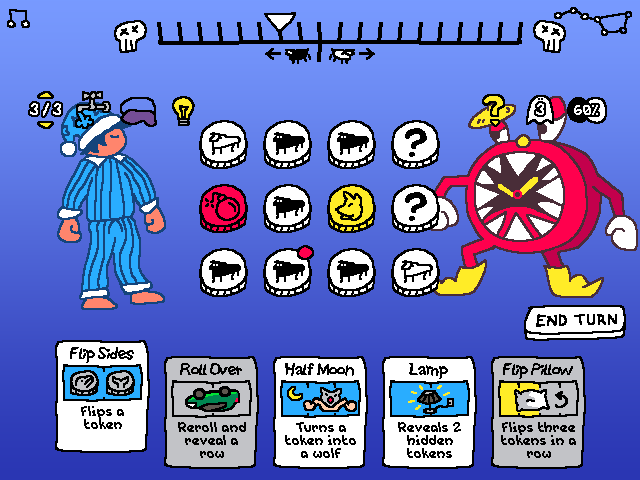
From a story perspective, Pillow Fight is a game about trying to get some sleep. In order to do that, the protagonist must count sheep which is where the gameplay of Pillow Fight comes from. Using an assortment of card-based abilities that are collected throughout the game, the player must ensure that the board contains more white sheep than black sheep at the end of each round. Numerous factors, including special tokens, enemy abilities, and a little luck, influence this ratio. Each of your abilities has a cooldown, and you only have a limited amount of times you can swap each sheep’s position on the board, so there is a deep strategy within the sheep-counting combat of Pillow Fight. Some of the rounds may come down to randomness, but it never feels unfair as the game gives you the odds and lets you work with them to the best of your ability. Even if you feel frustrated by an enemy, you likely won’t feel cheated.
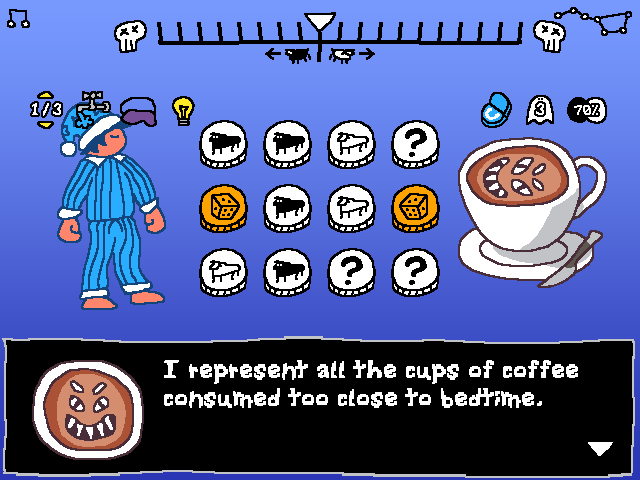
Once you’ve gathered the basics of the system, the game continues to throw curveballs and switch up mechanics in a way that keeps you engaged throughout all of its seven stages. Each stage has you facing off against a different enemy that is devoted to making sure you get less sleep. From the cup of coffee to the overheating thermostat, every enemy feels very thematically sound which is one of the surprising strengths of Pillow Fight. At the end of the battle, every enemy gives wholesome advice on how to maintain a better sleep schedule after they’re defeated, and those elements, which are also scattered throughout the UI and card design, add to the game’s charm.
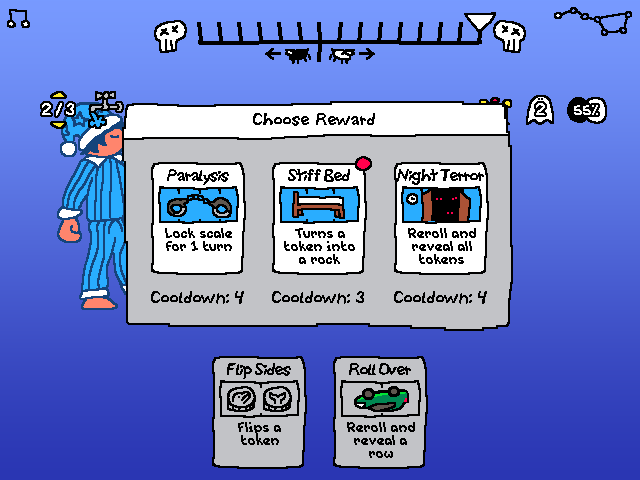
Although it starts with a simple tutorial, Pillow Fight certainly ramps up the difficulty as the game goes on. The gameplay is much more strategic than that of many other deck-builders as there are many different tokens and abilities to juggle all at once. Additionally, each enemy has more black sheep on the board, which makes your task of flipping them over and creating white sheep that much more challenging. At times, the game feels like a puzzle game as one could spend plenty of time racking their brain to figure out the most optimal play for a given situation. A run could last about 40 minutes, but on the game’s harder difficulty, there’s a chance for it to last over an hour as the enemies become that much more resilient.
However, thanks to the game’s relaxing soundtrack and visually appealing art style, none of that time feels taxing. The presentation is solid throughout, and it makes subsequent playthroughs with different card combinations feel just as rewarding as the first. All of these elements combine to create something that feels like sleep in its purest essence. There’s a sort of innocence to it all that just feels like icing on the cake for this already strong deck-builder.
With numerous different cards and abilities to choose from, Pillow Fight is an extremely strong entry into the deck-building genre. It not only delivers on its premise, but it does so in every facet of the game. The music, graphics, main menu, and mechanics all work in perfect harmony to create a game that is worth playing again and again until you drift off to sleep.